
July 29, 2021
Solved

Getting One Property Value From Dictionary Based Upon Another Property Value

  • July 29, 2021
  • 8 replies
  • 0 views

I have this expression rule and I need to get the value of one of the keys based upon whether another key property is true or false, I have this but doesn't work:

a!localVariables(
  local!myDictionary: {
    {
    item: 1,
    active: true,
    description: "Widget",
    color: "Green"}
    ,{
    item: 2,
    active:false,
    description: "another",
    color: "red"}
  },
  if(
  fn!index(local!myDictionary,"active","") == true,
    fn!index(local!myDictionary,"color",null), "")
)

To explain further: I would want to return the value "Green" from the key property color due to active property being true and not the value "red" because active property is false.
Best answer by stewart.burchell

Hi

Here's the code:

a!localVariables(
  local!myDictionary: {
    {
      item: 1,
      active: true,
      description: "Widget",
      color: "Green"
    },
    {
      item: 2,
      active: false,
      description: "another",
      color: "red"
    }
  },
  local!myDictionary.color[fn!wherecontains(true,fn!toboolean(local!myDictionary.active))]
)

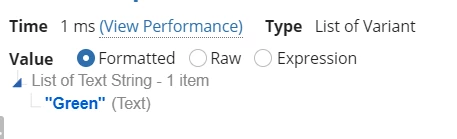
Here's the result:

...and here's an explanation:

  • you can address elements in an array using the square brackets
  • ...so we're looking to extract all of the color attribute values - addressed using local!myDictionary.color - where the corresponding 'active' attribute is true...
  • ...so we use the function 'wherecontains()' which returns the indices in an array that contain the the provided value. So, in our case, fn!wherecontains(true,<the array of local!myDictionary.active>)
  • the expression inside the square brackets returns the indices and is then used to return the values for the array that the square brackets are attached to

Hope this helps

8 replies

joshl
July 29, 2021

Close. There are a couple of notes. You should use a!map() instead of dictionaries to help resolve typing mismatch errors. With a dictionary you are probably getting a compare error with a list of variant and boolean. so that line should be more like 

if(toboolean(fn!index(local!myDictionary,"active","")),

Note: "if(predicate = true," and "if(predicate," are logically the same

Line 15 will give you a boolean array of the indices where "active" is true, but wherever you return false, you will get "" returned, so your snippet would return {"Green", ""}. You could store this result and filter out the nulls using filter() or a!forEach(), but I would write this like:

a!localVariables(
  local!myDictionary: {
    a!map(
      item: 1,
      active: true,
      description: "Widget",
      color: "Green"
    ),
    a!Map(
      item: 2,
      active:false,
      description: "another",
      color: "red"
    )
  },
  index(local!myDictionary.color, where(local!myDictionary.active), {})
)

alexl0007Author
July 29, 2021

You could store this result and filter out the nulls using filter() or a!forEach(),

Could this be a test case (forEach()) IF there were more than one true in the active property? Is this a correct assumption?

joshl
July 29, 2021

Can your expand your question or give an example? I'm not sure what you are asking.

stewart.burchell
July 29, 2021

Hi

Here's the code:

a!localVariables(
  local!myDictionary: {
    {
      item: 1,
      active: true,
      description: "Widget",
      color: "Green"
    },
    {
      item: 2,
      active: false,
      description: "another",
      color: "red"
    }
  },
  local!myDictionary.color[fn!wherecontains(true,fn!toboolean(local!myDictionary.active))]
)

Here's the result:

...and here's an explanation:

  • you can address elements in an array using the square brackets
  • ...so we're looking to extract all of the color attribute values - addressed using local!myDictionary.color - where the corresponding 'active' attribute is true...
  • ...so we use the function 'wherecontains()' which returns the indices in an array that contain the the provided value. So, in our case, fn!wherecontains(true,<the array of local!myDictionary.active>)
  • the expression inside the square brackets returns the indices and is then used to return the values for the array that the square brackets are attached to

Hope this helps

alexl0007Author
July 29, 2021

Great explanation with the bullet points. I was not aware you could use functions within the square brackets and the reason why I may have missed something simple as this, but now I know! Thank you for the help!