
November 17, 2025
Question

Issue while batching list of text string

  • November 17, 2025
  • 3 replies
  • 0 views

Hi Team,

Im trying a batch list of text items and prepare a query based on that. Below is my code snippet. With this code Im getting the last item of each list for the full batch of 50 items.

local!getAgreementIds: if(
    rule!APN_isBlank(
      index(
        index(local!PartnersResult, "data", null),
        "agreement__cr.id",
        null
      )
    ),
    index(
      local!AgreementResult.data,
      "agreement__cr.id",
      null
    ),
    index(
      local!PartnersResult.data,
      "agreement__cr.id",
      null
    )
  ),
  local!agreementDocIds: touniformstring(rule!APN_distinct(local!getAgreementIds)),
  
  local!batchedDocIds: a!forEach(
    items: enumerate(ceiling(length(local!agreementDocIds) / 50)),
    expression: local!agreementDocIds[
      (fv!item * 50) + 1 :
      min((fv!item + 1) * 50, length(local!agreementDocIds))
    ]
  ),
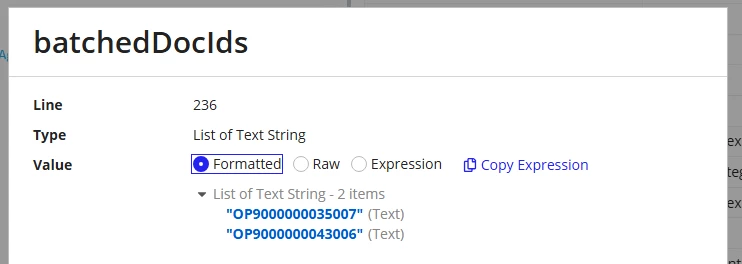
 

For ex: I have a list of 59 items, when I try to batch I should get 50 items in 1 batch and remaining 9 items in another batch. But Im getting last item of each batch that is 50th item in first batch and 59th item in 2nd batch. Can someone please help 

    3 replies

    November 24, 2025

    Use this logic:

    a!localVariables(
    /* Input: list of items to process */
    local!data: ri!items,
    /* or pv!allItems */
    /* Batch size */
    local!batchSize: 50,
    /* Compute number of batches */
    local!numBatches: tointeger(
    if(
    mod(length(local!data), local!batchSize) = 0,
    length(local!data) / local!batchSize,
    (length(local!data) / local!batchSize) + 1
    )
    ),
    /* Split manually into batches */
    a!forEach(
    items: enumerate(local!numBatches),
    expression: with(
    local!startIndex: fv!item * local!batchSize + 1,
    local!endIndex: min(
    {
    local!startIndex + local!batchSize - 1,
    length(local!data)
    }
    ),
    /* build the batch */
    a!forEach(
    items: enumerate(local!endIndex - local!startIndex + 1),
    expression: index(local!data, local!startIndex + fv!item, {})
    )
    )
    )
    )

    stefanhelzle0001
    November 24, 2025

    The following code turns a list of things into a list of lists of things.

    if(
      or(
        a!isNullOrEmpty(ri!items),
        a!isNullOrEmpty(ri!segmentSize)
      ),
      ri!items,
      a!localVariables(
        local!numSegments: ceiling(count(ri!items) / ri!segmentSize),
        if(
          ri!rotate,
          /* WITH ROTATION: segmentSize means the number of segments */
          if(
            ri!enablePadding,
            /* WITH PADDING: Adds type casted NULL values to the last segment to fill up to the size of the segment */
            a!forEach(
              items: enumerate(ri!segmentSize),
              expression: index(
                ri!items,
                1 /* First item in list is at index 1 and enumerate creates numbers starting at 0 */
                + fv!item /* Start number for current segment */
                /* Fix segment size */
                + enumerate(local!numSegments)
                * ri!segmentSize,
                cast(runtimetypeof(ri!items[1]), null)
              )
            ),
            /* WITHOUT PADDING: Only add left over items into the last segment. The last segment might contain less items */
            a!forEach(
              items: enumerate(ri!segmentSize),
              expression: reject(
                a!isNullOrEmpty(_),
                index(
                  ri!items,
                  1 /* First item in list is at index 1 and enumerate creates numbers starting at 0 */
                  + fv!item /* Start number for current segment */
                  /* Adjust the size of the segment to either the required size or for the last segment the left over items */
                  + enumerate(local!numSegments)
                  * ri!segmentSize,
                  null
                )
              )
            )
          ),
          /* WITHOUT ROTATION: segmentSize means the number of items per segment */
          if(
            ri!enablePadding,
            /* WITH PADDING: Adds type casted NULL values to the last segment to fill up to the size of the segment */
            a!forEach(
              items: enumerate(local!numSegments),
              expression: index(
                ri!items,
                1 /* First item in list is at index 1 and enumerate creates numbers starting at 0 */
                + (fv!item * ri!segmentSize) /* Start number for current segment */
                /* Fixe segment size */
                + enumerate(ri!segmentSize),
                cast(runtimetypeof(ri!items[1]), null)
              )
            ),
            /* WITHOUT PADDING: Only add left over items into the last segment. The last segment might contain less items */
            a!forEach(
              items: enumerate(local!numSegments),
              expression: index(
                ri!items,
                1 /* First item in list is at index 1 and enumerate creates numbers starting at 0 */
                + (fv!item * ri!segmentSize) /* Start number for current segment */
                /* Adjust the size of the segment to either the required size or for the last segment the left over items */
                + enumerate(min(ri!segmentSize, count(ri!items) - (fv!item * ri!segmentSize))),
                null
              )
            )
          )
        )
      )
    )

    bhavanai654706
    December 2, 2025

    You can batch a List of Text String (or any list) using a reliable slicing pattern with index().
    Range slicing inside a!forEach() often returns only the last item, so this approach avoids that issue.

    you can refer this code

    a!localVariables(
    local!items: local!agreementDocIds,
    local!batchSize: 50,

    /* total number of batches */
    local!numBatches: ceiling(count(local!items) / local!batchSize),

    /* list of lists */
    a!forEach(
    items: enumerate(local!numBatches),
    expression: index(
    local!items,
    1 + (fv!item * local!batchSize),
    min((fv!item + 1) * local!batchSize, count(local!items))
    )
    )
    )